


Interesting excursions, where you can find yourself immersed in luxuriant almost untainted nature, are possible at only a few kilometers from Abbaechelu, just the same as historical sites and enological and gastronomical attractions.
 The seascapes
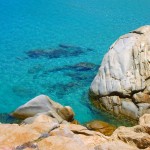
Inlets, beaches, cliffs and coves dot the coastline and are usually dominated by the presence of a stately watchtower that testifies to a past full of bloody battles and devastation.
The splendid coast is seldom crowded. Winding cliffs rise to the waves. The fine sand beaches gather themselves in candid dunes that are constantly being transformed by the sand’s movement and where only stubborn juniper trees resist.
The nearby Chia lagoon accommodates flamingo colonies that show off their pink and white plumage. They gracefully walk on their slender legs sunk into the water while their pink and black beaks scrape the bottom in search of food. They are called gent’arrubbia in the Sardinian language, connotative of the innate elegance that distinguishes them. Coots, little egrets and seagulls glide around them.
Le Dune is a long wide white fine-grained sand beach where 20 to 30 meter sand dunes gather behind it. The sand’s whiteness contributes to the intense and changing blue reflections of the water.
Between this oasis of incomparable beauty and the road that leads to a pond called Is Brebeis is a summer dwelling for many migratory birds. Cormorants, great-crested grebes and seagulls can be seen, while the coots and little egrets visit the shallower water and contend for it with the flamingos.
Moreover, what could possibly be said about the incomparable Tueredda and Cala Zafferano beaches?
Sant’Antioco Island, connected to the mother island by an artificial isthmus, has a geological morphology dominated by volcanic and calcareous rocks. It forms the Sulcis archipelago along with the island of San Pietro (Carloforte). They are both well known for the beauty of their towns and their crystal clear sea.
 Wild nature
As the enchanting seascape is left behind and we turn inland, an incredibly beautiful rough and wild scenario opens up where man’s presence is minimal.
Having made their homes in the uncontaminated inland where there are no inhabitants, the flora and the fauna are distinctive. You are likely to meet up with fox, wildcat, wild rabbit, partridge, buzzard and turtle among the excellent specimens of broom (cytisus), everlasting (helichrysum) spurge (euphorbia), and rush (galingale).
It is quite easy to reach the Monte Arcosu Natural Reserve, now a World Wildlife Fund natural oasis, or the Is Cannoneris Forest, incredibly green and frequented by the stately Sardinian deer. The offshoots of these natural reserves touch the Iglesiente territory, one of the largest concentrations of Mediterranean bush in the entire Mediterranean basin where holm oaks, cork oaks, wild olives, mastic trees, century old carob trees and arbutus or strawberry trees proliferate.
Many paths of varying difficulty unwind through the trees and the rocks where nature’s perfume and its myriad of colors all create for an intense emotional experience.
Is Zuddas, a wonderful grotto noted for its speleological importance is a few kilometers from Santadi. Stalactites, stalagmites and rare formations of the same give the name to the Organ room and the Eccentric Theater inside the grotto.
Those who love trekking, biking, bird watching, climbing, sailing, diving or windsurf have found their paradise.
 The history
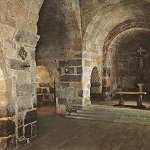
The island’s southwestern coast is rich in historical sites to the extent that a visitor practically “trips” onto its culture and traditions. Time has left some indelible marks related to the island’s first inhabitants and the trading of those peoples who navigated the Mediterranean in this most ancient geological area of Italy, inhabited since prehistoric times because of the wealth of its mineral resources and its fertile land, Montessu is a magnificent prehistoric stone necropolis.
It extends on a trachytic plateau that crowns a natural amphitheatre. Its elevated position dominates a fertile plain surrounded by hills. The burial ground is particularly fascinating for its numerous etchings – spiral, wolf teeth or bullhorns and fingerprints in red ochre symbolizing regeneration.
A path entangled in bush and sharp jutting granite shaped into bizarre forms by time reaches the monumental giants’ tomb in pink granite at Barrancu mannu. You find yourself immersed in one of the island’s most fascinating and evocative landscapes.
Sulcis, the island’s southernmost region, is the part of Sardinia where there are the greatest number of ports and towns founded by the Phoenicians and the Carthaginians. The name Sulcis is derived from the ancient Phoenician city, Sulki, traces of which remain on Sant’Antioco Island.
Nora was one of the most important commercial centers with three ports, the remains of which are still visible along with those of the Roman city. The theater, the impressive thermal baths and the paved streets with an efficient sewage system can also be visited. This archaeological site is one of the island’s oldest urban centers, inhabited from the nuragic age and of primary importance in the Punic-Carthaginian period. The most antique nucleus dates back to the IX-VIII century B.C.
Among the many archaeological finds brought to the surface in Nora is the homonymous stele from the IX century B.C. which represents the first example of writing found in the West and in which the name Sardinia appears for the first time in Phoenician – B Shrdn.
Bithia (now called Chia, is connected by the remains of an old Roman road to Cala Bernardini where Abbaechelu is located) and Cagliari are among the other Phoenician settlements.
Visits to the many cultural attractions – leaving little room for boredom – range from a small church at Perdiaxius to Saint Mary’s cathedral in Tratalias or the church in Sant’Antioco, the bishops seat until the fifth century, all of which are examples of Roman style architecture. The Vittorini monks of Marsiglia restored the church in Sant’Antioco at the beginning of the XII century.
Even Carbonia with its rationalist architecture merits attention. In addition, the Punic-Phoenician fortress on nearby Monte Sirai is one of the most important archaeological parks in all of Sardinia.
 Entertainment and culture
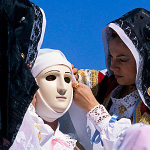
The town of Sant’Anna Arresi has hosted a jazz festival, “AI CONFINI TRA SARDEGNA E JAZZ”, every summer since 1986. Original music and artists on tour from Sardinia, Italy, Europe and America make up the program.
Nora hosts the “NOTTE DEI POETI”, a cultural happening under the stars in the evocative roman amphitheatre. No one should miss this event. Nora also has a Lagoon Center for Environmental Education that illustrates the various species of fish in the Sardinian sea with special attention given to the local species. The center is also used for the recuperation of injured turtles.
Every town in the area competes with the others in the preparation of festivals where the regional culinary specialties can be enjoyed. They know how to create exquisite dishes, each one slightly different from the town nearby, but similar just the same because of the use of local natural products.
Renting a silent sailboat or a light raft allows for visiting inlets of a solitary beauty that are otherwise unreachable by land. Nearby horse ranches allow for meeting animals that can be the silent companions on rarely travelled paths. On Is Molas’grass, you can play with a stick and a ball and try sending it into a hole with one or more shots.
It is even possible to just relax near the hotel’s large swimming pool and garden while listening to the chatter of birds and reconciling oneself with the world.